
From Student to Knowledge Creator at PTE: An Interview with Lillian Esau
Apr
07
From Student to Knowledge Creator at PTE: An Interview with Lillian Esau
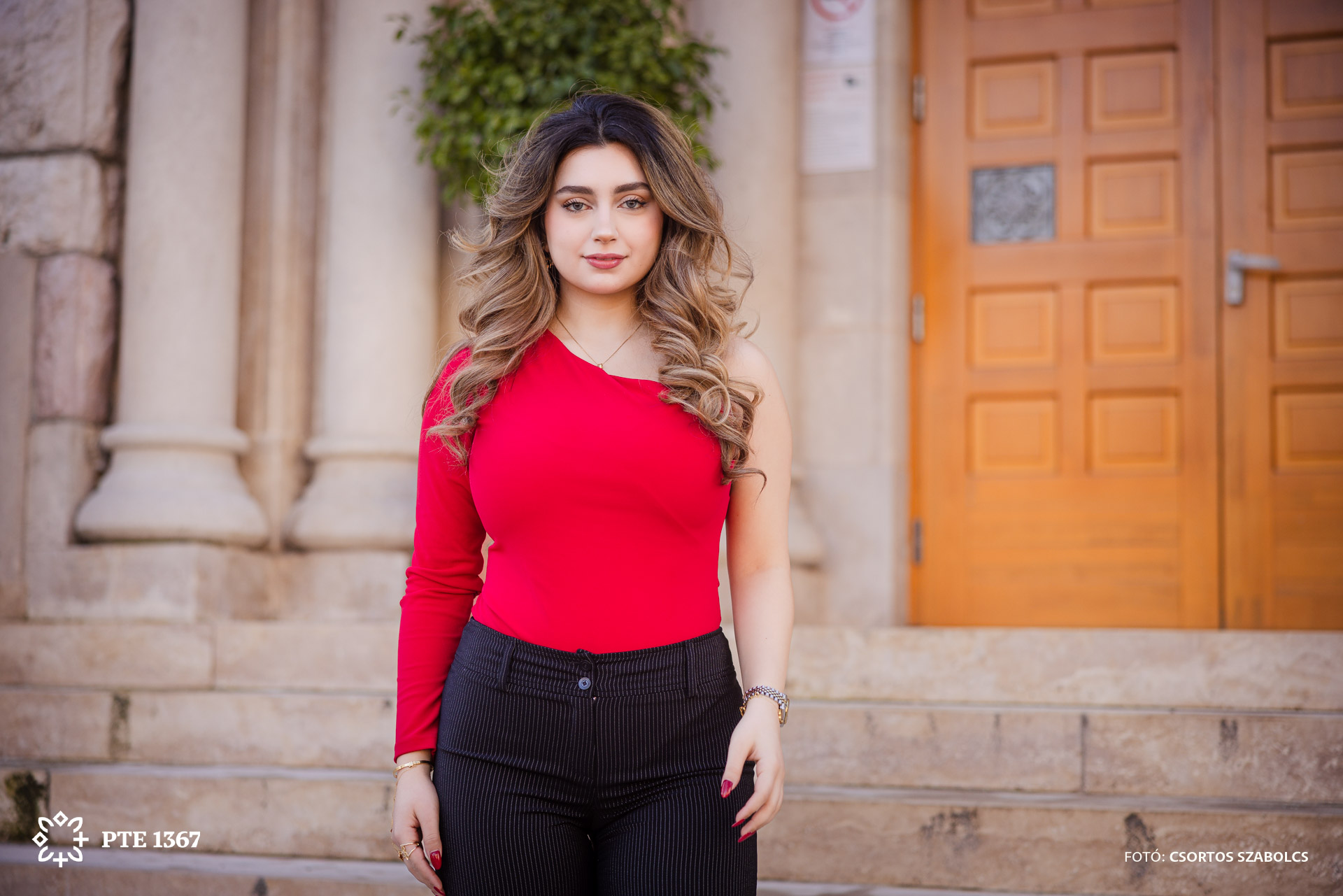
How does an architecture student become a defining figure within a university community? A former Master’s student at the University of Pécs (PTE) is now shaping the future as a PhD researcher and mentor. Her journey has led from research competitions to international alliances, while over the years, Pécs has become more than just a place of study—it has become her home and the primary engine of her personal growth.
Architecture is not merely about designing houses; it is about a deeper understanding of spaces, functions, and communities. Our interviewee completed her five-year, single-cycle (undivided) program at the University of Pécs (PTE), where she gained an exceptionally broad range of knowledge, spanning from urban planning and residential buildings to interior design. This complex perspective laid the foundation for the professional maturity that characterises her work today.
During her final years at university, it became clear that her path would lead towards academia and research alongside practical design. Her research within the framework of the TDK (Scientific Students' Associations) and two concurrent OTDK (National Scientific Students' Association) nominations provided a scientific base that made the transition to doctoral school feel like a natural progression. Furthermore, she served as a teaching assistant to her professor for two years—an experience she describes as a "mini PhD." Even as a student, she gained a taste of educational methodology and departmental administration, preparing her for the more intricate challenges of life as a researcher.
While many graduates enter the industry immediately or look towards new cities, the most compelling argument for her to stay was continuous and unquestionable personal development. Her mentor, Dr. Zoltán Erzsébet Szeréna, played a pivotal role in this process, supporting her professional growth for over six years. "She believed in me and all the potential I had, even when I perhaps doubted myself. She constantly challenged me and was my greatest inspiration to pursue a PhD," she recalls with gratitude.
This type of teacher-student relationship is one of the greatest draws of the PTE Pollack Mihály Faculty of Engineering and Information Technology, where educators do not simply deliver dry curriculum but act as mentors and professional partners helping students find their way. This environment of trust and an established professional network spared her from having to choose an uncertain fresh start elsewhere over a secure and supportive community.
"Starting a doctoral program requires a fundamentally different mental attitude compared to the Master’s years," Lillian explains. While students are previously guided by a well-defined curriculum, fixed exam dates, and tight deadlines, at the PhD level, freedom, self-management, and individual research ambition dominate.
"At this stage, you no longer just absorb knowledge through a syllabus; you yourself become a creator of knowledge," she notes poignantly. However, this freedom is a "double-edged sword," as the researcher must build their own daily routine, research milestones, and publication strategy. This shift requires internal maturation: evolving from student status into a responsible, independent professional and scientific creator. It is often a solitary process, but the PTE doctoral school provides the necessary professional background for this transition.
Although Pécs is calm and human-scaled in size, its international character and cultural vibrancy are surprisingly strong. During the interview, it was noted that the city's greatest advantages are its inclusivity, openness, and the opportunity to form deep, meaningful human connections. In a community where one bumps into familiar faces several times a day at Széchenyi Square or on the university campuses, relationships rarely remain superficial.
"As an international student, I always felt fully embraced. Although Hungarians can sometimes seem reserved or shy at first, once you find a common language, you find incredibly loyal and supportive friends." Diversity is also markedly present in the PhD program; her current cohort includes representatives from eight different countries and cultures, providing a unique global perspective to both collaborative architectural research and daily university life.
For her, the doctoral years do not mean isolated research locked in an ivory tower. During her time at the university, she has proven herself as a teaching assistant, an international mentor for the Stipendium Hungaricum program, and a board member of the EDUC (European University Alliance) student union. These roles have brought not only professional success but also opportunities to travel the world, build international networks, and acquire modern leadership skills.
In her experience, Hungary—and specifically the University of Pécs—serves as an excellent professional springboard for anyone willing to work for their goals: "If such high-quality opportunities are available to you as a student, one can only imagine the horizons that open up for a freshly graduated professional with a PhD in the labour market."
To those Master's students who are unsure whether to embark on a PhD, she suggests asking one vital, honest question: "Do I have that childlike curiosity and creative drive to carry me through the difficult days?" For those who constantly ask "why?" or "how could this be improved?", a PhD is not a burden, but the natural next step towards self-fulfilment.
A doctorate should be viewed not merely as an extra piece of paper, but as serious, creative work that demands patience and dedication. As her mother wisely advised her: an advanced degree is like an invisible shield, providing not only self-confidence but real security and authority amidst the unpredictable storms of professional life.
If this journey in Pécs could be summarised in three words, they would be growth, impact, and leadership. This story is bright evidence that PTE is not just an institution where one earns a degree, but a living environment capable of radically changing a young professional's worldview, preparing them to make a lasting mark on a global scale.


Blog archive
- September 2026
- August 2026
- July 2026
- May 2026
- April 2026
- February 2026
- June 2025
- December 2024
- July 2024
- December 2023
- April 2022
- March 2022
- February 2022
- May 2021
- April 2021
- March 2021
- February 2021
- January 2021
- December 2020
- November 2020
- August 2020
- July 2020
- June 2020
- May 2020
- April 2020
- March 2020
- December 2019
- November 2019
- June 2019
- May 2019
Blog posts








Faculties
University of Pécs
International Centre | Rector's Cabinet
H-7622 Pécs, Vasvári Pál str. 4.
+36-72/501-500/61682


University of Pécs | Chancellery | IT Directorate | Portal group - 2020.